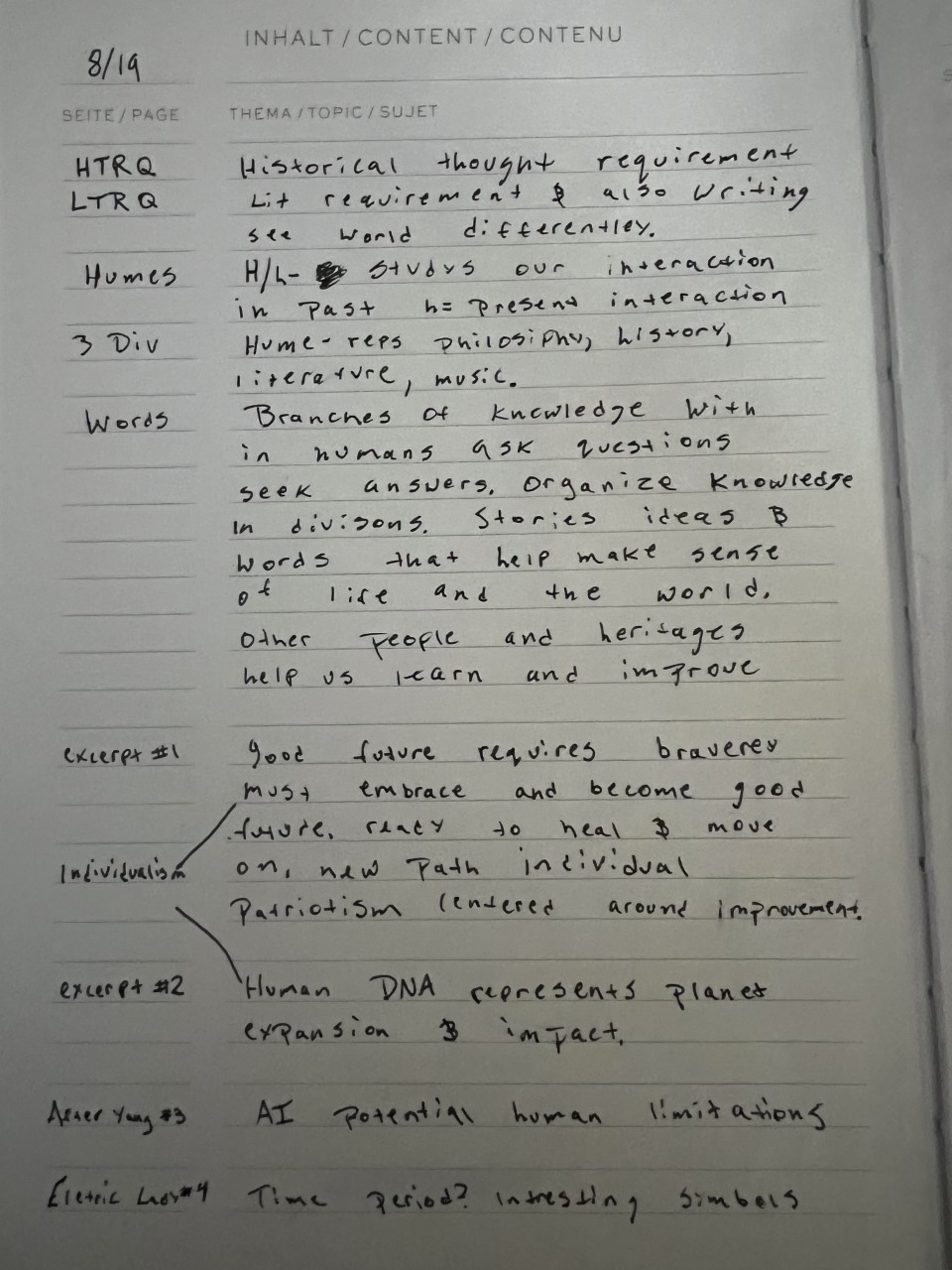
On our first night at Sapere Aude, we began the Humanities course by first defining what Humanities means; in addition, we also defined the humanities and discussed the distinctions between the two. Firstly we broke down both the humanities and Humanities into two categories: social and academic.
Let’s begin by discussing the academic category of the Humanities. The base definition of Humanities is an academic way of dividing knowledge, learning, and ways of knowing. These branches of study typically concern themselves with human beings, their culture, and their methods of acquiring such knowledge or culture. In the following passages, I will analyze the practice of Humanities throughout the course in relation to the coursework I have completed so far.
At the beginning of the year, in unit one, we started the course by reading and analyzing Jorge Luis Borges’s “The Garden of Forking Paths.” This chapter explores the concept of time and its relationship to decision-making. Borges outlines the importance of the decisions we make through a labyrinth that interprets the universe not as objective but instead as an infinite series of times that forever expand and explore endless possibilities that all depend on the choices or decisions we make in our lives. Borges’s work demonstrates the practice of Humanities as it explores the branches of decision-making and its relation to humanity or, on a broader scale, the universe.
Next, let us explore the practice of humanities. The humanities are generally defined as everyday interactions with people around us, specifically not in an academic setting. The humanities will typically concentrate on stories, ideas, and words that help us make sense of the world around us. A prime demonstration of the humanities in unit one occurred when I played Anna Anthropy’s game Queers in Love at the End of the World. This game explores an anonymous couple at the end of the world. In the game, you are one of the partners, and you have ten seconds to decide how you want to spend your last little bit of time on earth. As we discussed in plenary, this game emphasized one’s decisions in relation to those closest to them. In the last ten seconds of the world, whether you decide to kiss or hold your partner doesn’t impact the universe but will affect your partner. In other words, this game fits the definition of humanities because of its focus on intimate human relationships. For these reasons, I think both Borges’s “The Garden of Forking Paths” and Anna Anthropy’s Queers in Love at the End of the World perfectly show the differences between Humanities and humanities in unit one.
In unit two, we focused a lot on the concept of identity within a culture and on an individual level as well. Donna Haraway’s “A Cyborg Manifesto” is a perfect example. In this manifesto, Harraway addresses the social elements present in today’s society that cyborgs would change. Harraway describes constructs such as race, sexuality, and gender. What I found to be so interesting about this piece is that it contributes to the definitions of Humanities and humanities. As Harraway continues, she explains what it means to be a human in the role of society. In essence, she emphasizes the importance of one’s gender, race, or sexuality and how that impacts how one fits into society. Haraway’s argument in this manifesto is that these physical elements of what makes us human alter things that fall under the Humanities definition. For example, how one might look can create a prejudice that will impact their ability to learn or communicate with others that associate with that society.
This leads me to Harraway’s mention of cyborgs, which fall under the definition of humanities and emphasize the contrast between physical humans whose prejudice alters the branches of study within the Humanities. Harraway argues that if humans were to be cyborgs, our diversified appearances would prevent us from subscribing to any society or culture. Harraway believes that this sort of individuality would deepen our interactions by tearing down the walls of prejudice, allowing us to more efficiently, communicate, learn, etc. Because of the way Harraway emphasizes the difference between human and cyborg contributions to these definitions, I thought “A Cyborg Manifesto” perfectly represents the Humanities and humanities in unit two.
Lastly, in unit three, we discussed the power of interpretation. This mainly occurred in week twelve when we analyzed religious studies and interpretation’s roles in these studies. This study and interpretation of old texts fall under humanities as these interpretations of stories or lessons from religious texts impact how we see the world around us. More specifically, though, we explored who has the power to interpret such sacred texts. We found that throughout history and the interpretation of past events, only the western perspective is taught or respected, meaning that our understanding of these stories and lessons is filtered from the same kind of perspective every time. This narrows our experience and contact with other cultures, ideas, and interpretations, making this issue parallel to the one Harraway addressed, which is prejudice.
When reviewing the coursework I was going to include for these definitions, I noticed the theme of exclusion of other cultures or people. As I said, this dramatically narrows our experience and contact with different cultures and ideas. This leads me to believe that for either of the humanities to function properly, these features can not co-exist. What’s more, to produce the empathy necessary for the function of both H/humanities we can not value specific ideas or intellectual beliefs over others. We must instead embrace all beliefs, cultures, ideas, and values to understand how the world and universe around us genuinely work.