The Future

The time or a period of time following the moment of speaking or writing; time regarded as still to come. When consulting google for the definition of the future, this is the result. The issue with this definition is its one-dimensional nature. By this definition, the future isn’t something that exists. This definition also assumes the way time passes, which is incorrect to do. I will be giving a more in-depth idea of what the future means and entails in relation to the coursework I have completed thus far. So let’s start at the very beginning of the year and first discuss what the future is.
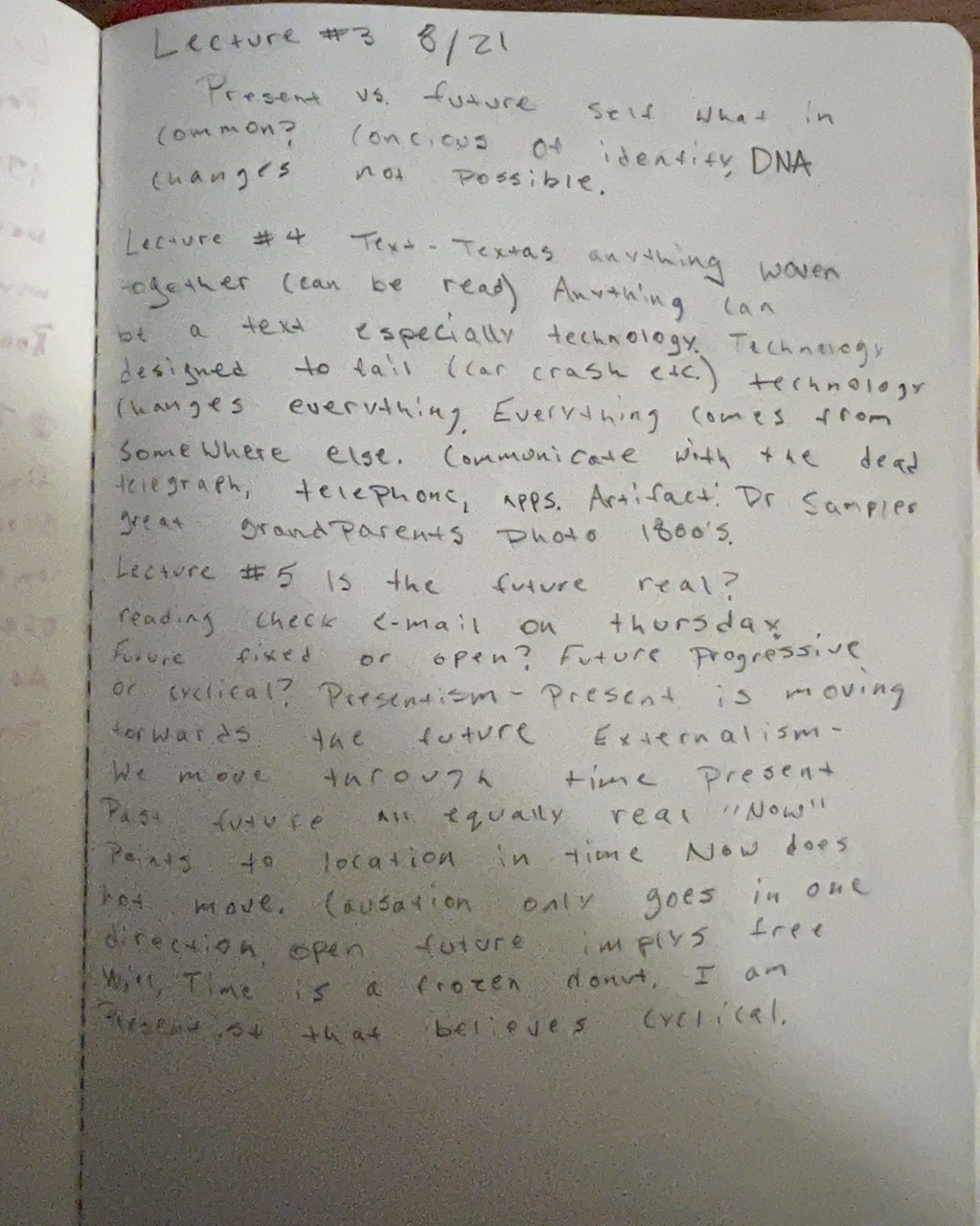
At the beginning of the year, during our time at Sapere Aude, we briefly addressed the question of the future. To look further into this question, we first investigated how this mysterious thing called time moves or passes. Though there is no sure answer to how time moves, there are two main theories surrounding this concept, which Dr. Robb introduced: presentism and eternalism. These ideas are highly relevant to the subject of the future because not only do they estimate how time moves, but presentism and eternalism indicate differing views of what the future is.
Let’s start with presentism. Presentism subscribes to the idea that only the present exists. This means that there is no future as, according to a presentist, it doesn’t exist at all. Presentism 100 years ago today might be completely different from how we interpret the past 200 years from now. In essence, everything revolves around the present. Though the past has happened, it no longer exists, just like though the future may happen that doesn’t exist either. In contrast, an eternalist believes quite the opposite. An eternalist would argue that the past, present, and future co-exist and are all equally real, so according to an eternalist perspective, the future you is just as actual and existent as the present you, which is just as existent as the past you.
Clearly, we can see how these two beliefs contrast and are virtual opposites. Though the passing of time is notoriously ambiguous, these two concepts helped me narrow down my ideas and discover my own idea of what the future is. After thinking about what these two concepts imply, I subscribed to the view of the presentist. My conclusion was heavily influenced by further coursework we did throughout unit one. Specifically, in Ted Chiang’s paper “What’s Expected of Us.” In this paper, Chiang talks about a world with no free will. In other words, it is a world where everything is already set and predetermined. Though eternalism does not blatantly imply that the future is predetermined, I find the idea that the future is just as real as the moment I’m in now hard to believe. In other words, I think that the present completely determines the future. What I do now will influence how my “future” self will live. I don’t believe that the future exists, and I don’t think my actions will simply lead me into that predetermined moment. It is for these reasons that I think that the future is nothing. I believe all there is, is now and what will come depends on the now.
In unit two, we considered the question of who the future is. In other words, we primarily focused on what it means to be a human in the coming centuries. In this unit, I was first introduced to the concept of a cyborg. This came within the first week of unit two when I read We3, which introduced the idea of biological life merging with machines by only showing domestic animals like cats and dogs making this transition. Despite the novel only depicting animals merging with machines, We3 provided great foreshadowing when imagining humans in the future. This foreshadowing leads me to Donna Haraway’s “A Cyborg Manifesto,” which does address humans merging with technology through the idea of cyborgs. Firstly, Haraway defines what it means to be a cyborg. In this particular manifesto, a cyborg is a being containing elements from both machines and living organisms. In this manifesto, Harraway addresses not so much the physical features that would come with being a cyborg but rather the social elements instead. The manifesto addresses constructs such as race, sexuality, and gender. All things that Harraway feels divide us. Through cyborgs, Harraway feels that these divisive constructs can be torn down and tailored to an individual level rather than a societal one. It is for that reason that I feel the future is technology. I believe the future is cyborgs or humans merging with machines, not only because of all the physical advantages that could come from merging, but also the societal improvements. For these reasons, I feel that merging our identities with technology seems inevitable as we look to the future.
In unit three, we explored when the future is. This question is best answered in Susan Schneiders’s Artificial You. Similarly to “A Cyborg Manifesto,” Artificial You also discusses the possibility of humans merging with technology. The only difference is that Schneider discusses it as completely transitioning to AI instead of merging with it. This is through a process called uploading. “Uploading” refers to the process of uploading your conscious brain into a computer. This would result in immortality and the option to set reality to however you want to perceive it. In addition to the modern-day research Schneider discusses regarding uploading, she also describes how AI influences our lives today. Without AI, you wouldn’t be able to read this paper the way you currently are, and if you have glasses, you are relying on the technology you have implemented on your face to improve your performance. These technologies that could improve our way of life are already upon us, which is why I believe the future is now.
As the year progressed, something new that I feel defines the future is the past. This realization was made when we discussed Setaey Adamu Boateng’s Zong! These discussions opened my thinking to understand that part of the future is thinking about and interpreting the past. When I think about the future I cant help but wonder how my existence will be interpreted. This leads me to the concept of archives and its importance in defining and in paving the way for the future. Archives are signs of the past, the majority of archives we have interacted with in Humes have been written archives due to the lack of technology in the time periods we were analyzing. Regardless of the forms these archives take their power to alter or reveal a new narrative is what makes them so important. An example of the revelations that can be found in archives can be seen when I wrote my third paper. For my third paper I analyzed a primary source (a newspaper article form the 1960’s in Ghana) and got to see the things this archive revealed about life in Ghana a decade after independence. The Eurocentric ads in this newspaper alone was enough to reveal that even though Ghana had been independent for a decade they still had an economic relationship with the very country that controlled them until only ten years prior. This example of what archives can reveal about a society shows that in the future they will almost certainly be as important as they are now. Because of the technological advances we have made since these archives, in the future because of the internet and social media archives will be so much more accessible and detailed thanks to technology. So as I previously stated that tech is the future, that is present again when thinking about the way in which technology can help us in the future account for the past.
I must admit that at a certain point in unit 5 I felt quite hopeless when thinking about the future. This hopelessness mainly stemmed from when we discussed a future without children. When thinking about the core reason of why we do virtually anything in life it seems we do it out of a place to create the possibility of a bright future, however how can this future carry on without children? Though the notion of a world without children sounds outlandish after doing extensive research on technology this idea doesn’t seem so far fetched. Though the pieces we discussed in class related infertility to an unknown medical issue I feel that a lack of reproduction may be a product of technological advancements. Take dating for example, if I can date anybody I could ever want in a reality that is indistinguishable from the one in which I currently reside, why would I ever put effort and the possibility of rejection on the table? This is where our discussions about collective responsibility becomes vital in relation to the future. As the future approaches us everyday it is critical to think about how our actions will impact those that come after us. This is why despite the convenience and pleasure that things such as technology will bring us, we must make it morally unacceptable to carry out an action out of a desire for easiness or utter pleasure that will in any way jeopardize or endanger the future of humanity. It is for these reasons that I feel that the future is upon us now and as agents that can manipulate the future it is our duty to carry out a life full of morale and virtue that will give future humans a fair chance of thriving.
Humanities
On our first night at Sapere Aude, we began the Humanities course by first defining what Humanities means; in addition, we also defined the humanities and discussed the distinctions between the two. Firstly we broke down both the humanities and Humanities into two categories: social and academic.
Let’s begin by discussing the academic category of the Humanities. The base definition of Humanities is an academic way of dividing knowledge, learning, and ways of knowing. These branches of study typically concern themselves with human beings, their culture, and their methods of acquiring such knowledge or culture. In the following passages, I will analyze the practice of Humanities throughout the course in relation to the coursework I have completed so far.
At the beginning of the year, in unit one, we started the course by reading and analyzing Jorge Luis Borges’s “The Garden of Forking Paths.” This chapter explores the concept of time and its relationship to decision-making. Borges outlines the importance of the decisions we make through a labyrinth that interprets the universe not as objective but instead as an infinite series of times that forever expand and explore endless possibilities that all depend on the choices or decisions we make in our lives. Borges’s work demonstrates the practice of Humanities as it explores the branches of decision-making and its relation to humanity or, on a broader scale, the universe. This is an interesting notion as later we combatted this ability to make desicons.
Next, let us explore the practice of humanities. The humanities are generally defined as everyday interactions with people around us, specifically not in an academic setting. The humanities will typically concentrate on stories, ideas, and words that help us make sense of the world around us. A prime demonstration of the humanities in unit one occurred when I played Anna Anthropy’s game Queers in Love at the End of the World. This game explores an anonymous couple at the end of the world. In the game, you are one of the partners, and you have ten seconds to decide how you want to spend your last little bit of time on earth. As we discussed in plenary, this game emphasized one’s decisions in relation to those closest to them. In the last ten seconds of the world, whether you decide to kiss or hold your partner doesn’t impact the universe but will affect your partner. In other words, this game fits the definition of humanities because of its focus on intimate human relationships. For these reasons, I think both Borges’s “The Garden of Forking Paths” and Anna Anthropy’s Queers in Love at the End of the World perfectly show the differences between Humanities and humanities in unit one.
In unit two, we focused a lot on the concept of identity within a culture and on an individual level as well. Donna Haraway’s “A Cyborg Manifesto” is a perfect example. In this manifesto, Harraway addresses the social elements present in today’s society that cyborgs would change. Harraway describes constructs such as race, sexuality, and gender. What I found to be so interesting about this piece is that it contributes to the definitions of Humanities and humanities. As Harraway continues, she explains what it means to be a human in the role of society. In essence, she emphasizes the importance of one’s gender, race, or sexuality and how that impacts how one fits into society. Haraway’s argument in this manifesto is that these physical elements of what makes us human alter things that fall under the Humanities definition. For example, how one might look can create a prejudice that will impact their ability to learn or communicate with others that associate with that society. Because of this I feel that the definition of humanities isn’t only a framework of thinking but also a framework of living and portraying your identity to other’s.
This leads me to Harraway’s mention of cyborgs, which fall under the definition of humanities and emphasize the contrast between physical humans whose prejudice alters the branches of study within the Humanities. Harraway argues that if humans were to be cyborgs, our diversified appearances would prevent us from subscribing to any society or culture. Harraway believes that this sort of individuality would deepen our interactions by tearing down the walls of prejudice, allowing us to more efficiently, communicate, learn, etc. Because of the way Harraway emphasizes the difference between human and cyborg contributions to these definitions, I thought “A Cyborg Manifesto” perfectly represents the Humanities and humanities in unit two. Furthering this idea of identity which makes up a large portion of the humanities definition, though Harraway feels that a society may feel more productive and welcoming with out social boundaries of race and gender after understanding the stories and healing and power that a culture can provide a group of people with I heavily disagreed with her notion. Though prejudice is still unfortunately common in humanity I feel that what gives us strength and hope is this connection to groups of other people that hold a similar identity to us. Though the termination of concepts such as race and gender could potentially prevent prejudice I feel that these characteristics are what connect and make humans human. My argument can be supported by Beyonces movie we watched later in the year Black Is King. This movie focused on the rich culture of Africa and how this culture can be distributed throughout the diaspora. The sense of community and history that can be found in forms of identity such as gender and race simply make these aspects of humanity to important to replace or alter.
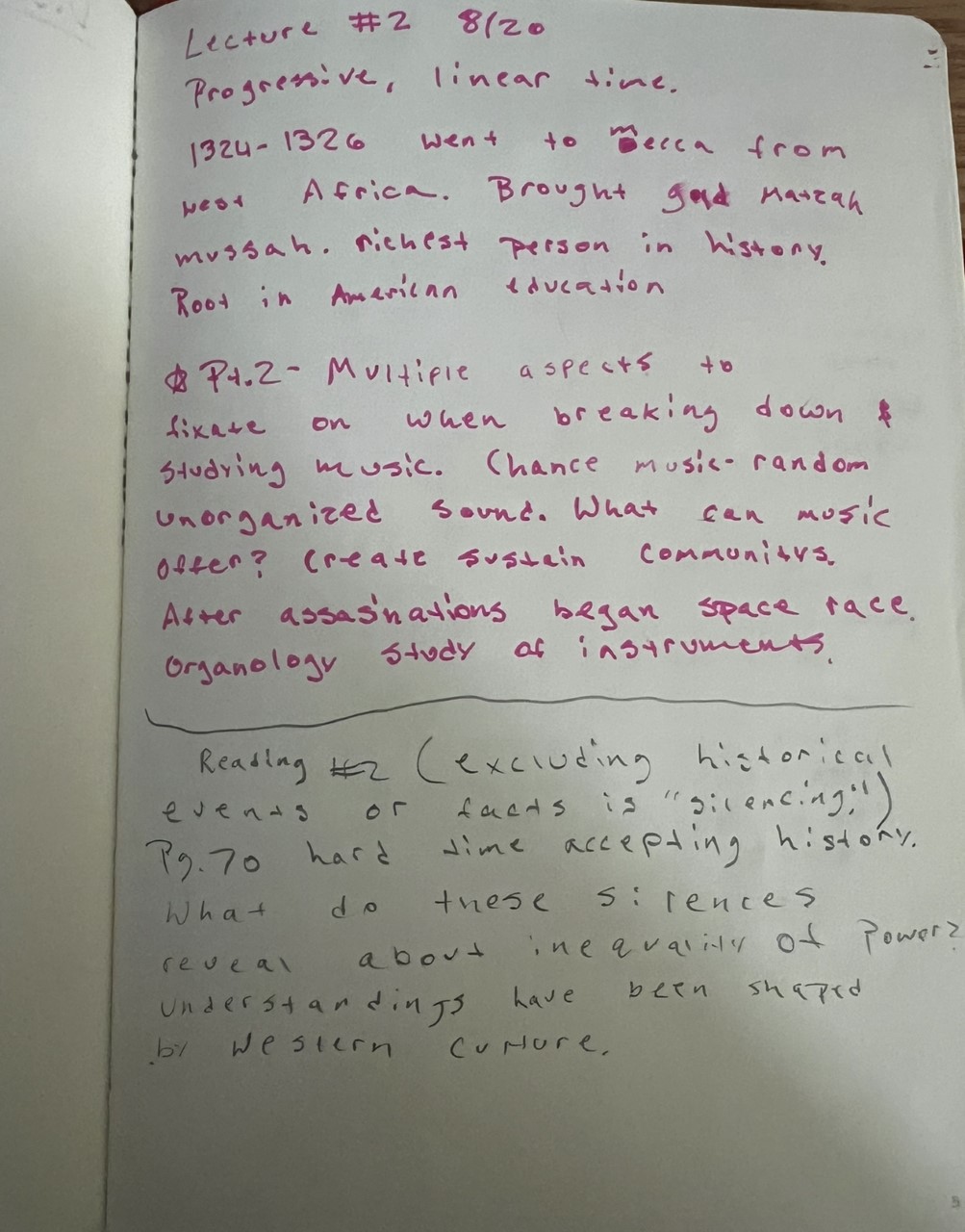
When trying to further define Humes I found myself thinking back to our discussions about the power of interpretation. Specifically in week twelve when we analyzed religious studies and interpretation’s roles in these studies. This study and interpretation of old texts fall under humanities as these interpretations of stories or lessons from religious texts impact how we see the world around us. More specifically, though, we explored who has the power to interpret such sacred texts. We found that throughout history and the interpretation of past events, only the western perspective is taught or respected, meaning that our understanding of these stories and lessons is filtered from the same kind of perspective every time. This narrows our experience and contact with other cultures, ideas, and interpretations, making this issue parallel to the one Harraway addressed, which is prejudice. For this reason I attribute an aspect of humanity to the practice of suppression.
A realization that really interested me when thinking about a sole defining factor of humanity is the notion of impermanence. This idea of the importance of impermanence was specifically addressed when we discussed critical fabulation. Critical fabulation is the use of storytelling and narration to analyze or discuss something in the past. When studying critical fabulation something I noticed is that its potential danger is that it continues to exploit people who have already died. This notion was also brought up when we discussed phantasmagoria and the way in which the music industry is exploiting dead artists. So it seems that a core element of humanity is its impermanence. Though archives are critical to retell the past its vital to allow those who have died to move on and not limit their whole existence to a small portion of their lives. Because of this a core element of the humanities is impermanence.
Finally I think our discussions regarding collective responsibility should be what I leave you with as collective responsibility translates to one of the defining elements of the humanities on a collective level. I think the core of humanity is our obligation to take responsibility for our actions not just on an individual level but on a collective level also. If everyone could feel collectively responsible for the faults in the world, it would be a much better place and give future generations a chance at harmonically thriving. This collective responsibility is necessary because without it prejudice, exclusion and harm to the planet will continue to occur. The absence of collective responsibility narrows our experience and contact with different cultures and ideas. This leads me to believe that for either of the humanities to function properly, collective responsibility and a future must exist. What’s more, to produce the empathy necessary for the function of both H/humanities we can not value specific ideas or intellectual beliefs over others. We must instead embrace all beliefs, cultures, ideas, and values to understand how the world and universe around us genuinely works.

